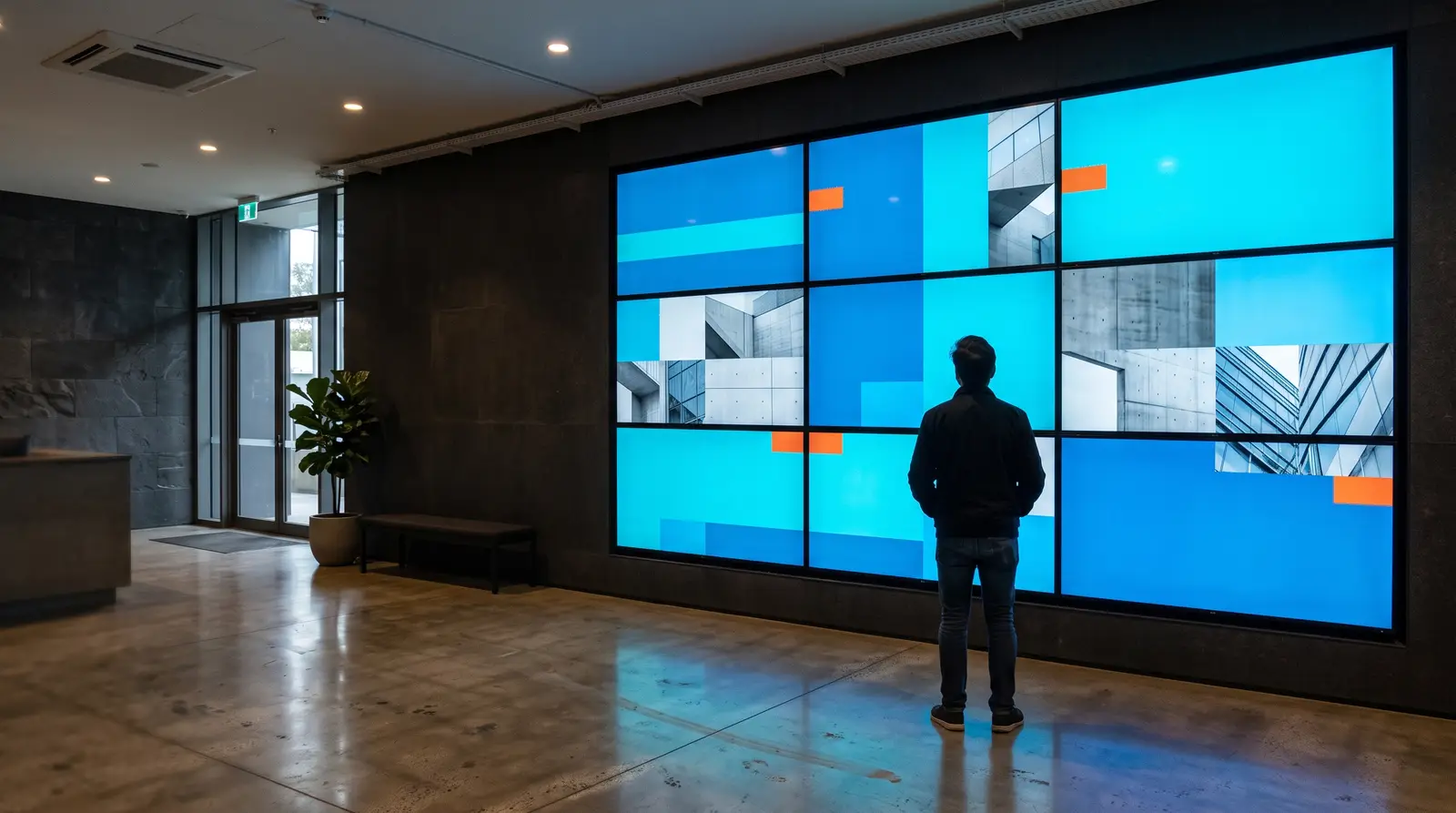

What is a video wall in digital signage?
Search "video wall software" and you’ll mostly find AV control-room processor vendors selling dedicated hardware, a different category from signage CMS platforms. Here’s what a video wall actually is, and how CloudyFy TV builds one without that hardware.
- Video wall
- A video wall is a grid of individual screens arranged edge to edge to display one large, coordinated image or a set of tiled content. In software-based digital signage, ordinary displays are synchronized so each one renders only its own portion of the whole canvas, rather than relying on a single oversized panel or dedicated AV hardware.
Video wall (software) vs video wall processor (hardware)
Video wall (software)vsVideo wall processor (hardware)
Searches for "video wall software" often surface AV control-room processor vendors selling dedicated hardware boxes that genlock multiple feeds into one frame-locked image. That’s a different product category from a signage CMS. CloudyFy TV’s video wall is software-coordinated: it runs on the same ordinary players used for any other screen, computing each tile’s viewport in the CMS rather than frame-locking signals in a hardware processor. CloudyFy TV’s wall is not frame-locked or genlocked, and it doesn’t need to be for typical retail, lobby or menu-board use: coordinated switching within about a tenth of a second is close enough that viewers don’t notice a seam.
How does a video wall work in CloudyFy TV?
A CloudyFy TV Display Wall is built in the walls designer as a grid up to 5x5 in the CMS (8x8 in the underlying schema), where each tile is an ordinary paired player, not special-purpose hardware. The server computes every tile’s viewport, including millimetre bezel compensation, and coordinates switching to within about plus or minus 100 milliseconds on a wired LAN. Video wall is a paid add-on, and every tile in the grid consumes one screen seat, the same as a standalone screen.